
Concrete tamping is the process of compacting freshly poured concrete to remove air pockets and help the mix settle evenly. This step pushes coarse aggregates downward, brings cement paste upward, and ensures the concrete achieves maximum density before it starts to set. A simple way to picture it: if concrete is a mixture of stones, […]
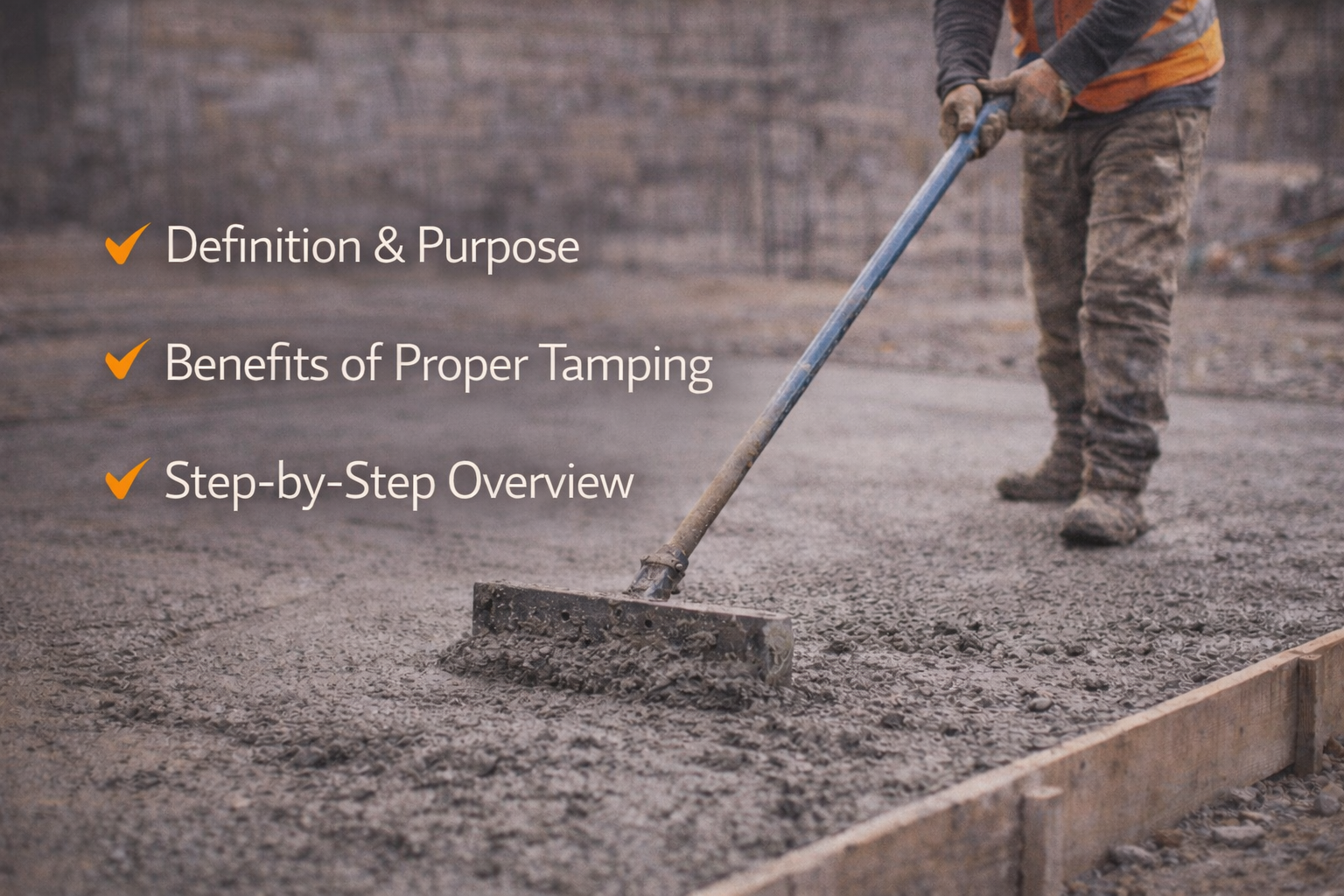
Concrete tamping is the process of compacting freshly poured concrete to remove air pockets and help the mix settle evenly. This step pushes coarse aggregates downward, brings cement paste upward, and ensures the concrete achieves maximum density before it starts to set.
A simple way to picture it: if concrete is a mixture of stones, sand, and cement suspended in water, tamping helps all the components lock together tightly, creating a stronger, more stable final form.
The tools vary depending on the project:
Concrete tamping is not a cosmetic step. It is a structural requirement that directly affects the lifespan and performance of the finished surface. When tamping is done right, the entire structure benefits.
Fresh concrete traps air during mixing and pouring. If left inside the slab, these air pockets become internal voids that weaken the structure. Tamping forces them out, giving the concrete the density it needs for maximum strength.
Without tamping, aggregates may float or sit unevenly. Proper tamping settles the stones into place, ensuring the mix cures with uniform strength from top to bottom.
Dense, well-compacted concrete can withstand heavier loads, resist cracking, and stay stable for decades, making tamping essential for driveways, foundations, patios, pathways, and commercial floors.
Honeycombing occurs when concrete cures with visible gaps, rough surfaces, or exposed aggregates. Proper tamping eliminates this issue completely, resulting in a smooth, cohesive finish.
Untamped concrete develops micro-voids that allow water to seep in. Over time, this leads to internal damage, freeze-thaw cracking, and reduced lifespan. Tamping seals these pathways by creating a solid, compact mass.
Not every concrete mix requires tamping, but many do, especially mixes with a lower slump (more rigid or semi-dry consistency). These include:
More fluid mixes often need vibration instead of tamping. The key is using the right compaction method for the right mix.
Skipping tamping may seem like a time-saving shortcut, but it often leads to serious and expensive problems.
Voids inside the concrete drastically weaken its load-bearing capacity.
Air pockets and poorly settled aggregates cause dips, high spots, and waves in the finished surface.
Weak points created during the pour eventually turn into visible cracks, often sooner than expected.
Untamped concrete rarely reaches its intended structural lifespan, increasing long-term maintenance costs.
Rough patches, exposed stones, and honeycombing reduce the visual quality and value of the project.
Proper tamping prevents all these issues from the start.
Professionals follow a strict process to ensure tamping is done right and the concrete cures to full strength.
A job requiring a tamping beam should never be compacted with a rod, and vice versa. The right tool ensures even pressure across the surface.
Tamping must be applied evenly across the slab, with consistent pressure and spacing. Uneven tamping leads to inconsistent density.
Compaction should reach the full thickness of the concrete, not just the top layer. Skilled tampers know exactly how deep to go without overworking the mix.
Tamping must be done immediately after pouring, before the surface starts to bleed or set.
These methods ensure the slab achieves maximum compaction without segregation or surface weakening.
DIY tamping often results in:
Professionals understand the behaviour of each concrete mix and apply consistent, accurate compaction. The result is a smoother, stronger, longer-lasting slab.
When tamping is paired with high-quality ready mix concrete, the benefits multiply. Ready mix ensures:
The combination creates a slab with exceptional durability, strength, and structural integrity.
If you want concrete that lasts, tamping should never be an afterthought. Proper tamping ensures density, eliminates air pockets, prevents cracking, strengthens the structure, and improves the long-term durability of your project.
At Quick Concrete Pumping, we combine high-quality concrete delivery with expert tamping and professional compaction methods to ensure your slabs, driveways, foundations, and floors stand the test of time.
We deliver throughout Kent, Surrey, and across a wide range of locations including Brighton, Brixton, Bromley, Chiswick, Chelsea & Kensington, Clapham, Crawley, Croydon, Dorking, Ealing, East London (selected areas), Epsom, Guildford, Godalming, Hammersmith & Fulham, Horsham, Islington, Kingston Upon Thames, Leatherhead, Mitcham, Redhill, Reigate, Richmond, Sutton, Streatham, Tooting, Tunbridge Wells, Wandsworth, West London, and Westminster.
If you have a query regarding a concrete delivery to an area not listed, please call 0203 039 3190.
